
The road ahead for the markets in the short term will depend on external factors rather than domestic developments.

Eurozone's financial contingency plan is trying to solve the problem of excessive debt with even more debt.

Experts suggest domestic factors rather than the Greece crisis would determine the course of the Indian equities.

Select companies in infra, capital goods, private banks, auto, oil & gas, and mining could be considered by investors.

The rupee depreciated 20 paise to close at 63.84 in Monday's trade.

The result of the opinion polls would allow the government to move ahead quickly to reach a deal with creditors

Going forward, markets will take cues from Reliance Industries earnings on Monday, and the Reserve Bank of India's policy on Tuesday on rate hike.

It is useful to note that Indian markets have not gone into a tailspin as the Greece crisis has developed, says Devangshu Datta.

The World War I had been triggered by an assassination in then relatively unknown Serbia.

Wolfgang Schauble has done right by the Euro zone, but the Greeks believe that doesn't necessarily mean he has done right by them.

At the BSE, 1,791 stocks declined, while 948 advanced, 110 stocks remained unchanged.
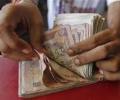
Increased demand for the dollar weighed on the local currency.

We bring you a presentation of some of the best photos from around the world in the month gone by

The euro skidded to a 6-week low of 133.700 yen in the early session.

Markets closed in the red on domestic worries.
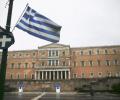
Energy Minister Panagiotis Lafazanis and Deputy Labour Minister Dimitris Stratoulis also voted against the package.

Consequences of China's efforts to stabilise its equity markets after three weeks of declines, which wiped out some 30 per cent of the value is far more importance to the world, says Clyde Russell.

ONGC, Sesa Sterlite, Tata Steel, RIL and HDFC emerged as the biggest losers

The second half of June could be driven more or less by technical factors triggered by news flow from Greece, the US Federal Reserve and the monsoon. The technical picture seems bearish as of now, says Devangshu Datta.

The m-cap of ONGC dipped Rs 13,303.78 crore, while that of Infosys tanked Rs 12,162.32 crore

With automation taking place at a much faster pace across industries especially in the tech space, domestic software firms that employee over 16 million are set to slash headcounts by a massive 3 million by 2022, which will help them save a whopping $100 billion mostly in salaries annually, says a report. The domestic IT sector employs around 16 million, of them around 9 million are employed in low-skilled services and BPO roles, according to Nasscom. Of these 9 million low-skilled services and BPO roles, 30 per cent or around 3 million will be lost by 2022, principally driven by the impact of robot process automation or RPA. Roughly 0.7 million roles are expected to be replaced by RPA alone and the rest due to other technological upgrades and upskilling by the domestic IT players, while it the RPA will have the worst impact in the US with a loss of almost 1 million jobs, according to a Bank of America report on Wednesday.

Market breadth was positive as 1187 stocks advanced for 1643 stocks which declined.
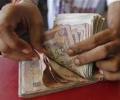
The greenback's strength against other Asian currencies and lacklustre local equity markets made the rupee depreciate.

The domestic currency had gained seven paise on Friday.

Barcelona's Champions League last-16 second leg match with Napoli scheduled for March 18 will take place without spectators due to fears over the spread of the coronavirus, a club spokesman said on Tuesday. The match will take place at Camp Nou after a 1-1 draw in Napoli, but no supporters will be allowed to enter the stadium.
A draught beer-font shaped man-of-the-match award will be presented to one player in each of the 31 matches.

Eurosceptics lined up to laud Greek democracy for disowning what some cast as the oligarchy

Sensex seems to be under pressure on weak cues.

Modi's Atma Nirbhar Bharat Abhiyan or Self-reliant India Mission is about 10 per cent of India's GDP in 2019-20 and would rank behind Japan, the US, Sweden, Australia and Germany. But unlike most of the relief packages announced globally, Rs 20 lakh crore is not entirely in new spending and includes Rs 1.7 lakh crore package the government had announced in March as well as the steps taken by the Reserve Bank of India (RBI) such as liquidity enhancing measures and interest rate cuts.

Rupee is likely to remain under pressure due to domestic concerns.

BSE Metal and IT indices plummeted by almost 2%

The next round of bad news could come from Europe, where banks in a number of economies such as Italy, Portugal and Greece are sitting on mountains of bad loans.

Banks bore the brunt of the sell-off.
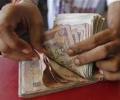
The Indian rupee had lost 10 paise to close at 64 on Thursday.

Prime Minister Alexis Tsipras battled to win lawmakers' approval on Wednesday for a bailout deal to keep Greece in the euro and avoid bankruptcy, as the IMF pressured Greece's creditors to provide massive debt relief for its crippled economy.
European politicians who insisted on introducing the euro in 1999 ignored the warnings of economists.

India's aggregate NPA as a percentage of GDP is far lower than that in Italy, Greece.

The euro climbed 1.3 percent against the yen to 135.60 and added 0.7 percent against the dollar to trade at $1.1115.

Positive cues from Asian peers also uplifted the sentiment.
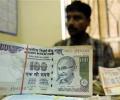
Indian rupee washed out initial losses against the greenback.
 © 2026 Rediff.com - Advertise with us - Disclaimer - Privacy Policy - Sitemap - Feedback - About us - Terms of use - Grievances